The era of tablets: Prelude to a wider digital divide?
 No one predicted its emergence decades ago but as we now see, these latest gadgets are about to become as ubiquitous as mobile phones over the next few years as more and more people are fast becoming tech savvy, internet addicts and social network slaves (wait a minute, is this me?).
My very first personal mobile phone way back in 1997 was an analog Nokia 501, with a famous shape that closely resembles that of a traditional ice shaver popularly used by households during the 80’s to tediously prepare a soothing halo-halo.
Next came the era of GSM phones with models that enabled the transmission of SMS in no more than 40 characters however, compared to the 160 characters capacity per sending of most latest phone models today.
 In 2000, when text messaging became very popular, I had my phone upgraded to the more fashionable and sleek at that time– the handy and trendy Nokia 5110 with changeable faceplates that come in different colors and designs.
By 2001 and 2002, Nokia had launched a flurry of slimmer and more compact mobile phone models with better features. And building on the revolutionary path of text messaging, Multimedia Messaging Service (MMS) took mobile communication to a new height.
With MMS-enabled mobile phones, people are able to send still images, video clips, text and audio messages over the air, especially with phones that have an integrated camera (who could forget the Nokia 7650, the world’s first phone with integrated camera designed for GSM networks).
Moving on to 2003, I had my first taste of a PDA (personal digital assistant) gadget with HP Jornada which allowed me to mostly send and receive work related emails with attachments, and remotely browse through the internet for news updates.
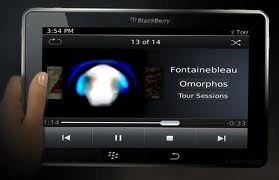 Then in 2005, I upgraded to PDA integrated mobile phone, the once famous XDA, then the XDAIIs, which I still keep to this day and sometimes use as an alternate phone for other pre-paid numbers.
Fast forward to 2008, just as emails had become a regular part of my 24/7 life, I started to enjoy and appreciate the convenient features of a Blackberry phone (the very phone brand I then considered as “alien” since I was used to having Nokia and XDA models).
With its push email features, email messages get to my phone inbox real-time the way text messages do the moment they are sent to me. On top of that, I wouldn’t be needing a PC to browse the web, interact through Facebook and Twitter, and even post for my blog.
 But 2010 left a phenomenal mark with the launch of such revolutionary products as iPad (Apple), Black Pad (Blackberry), Eee Pad (Asus), Idea Pad (Lenovo), Palm Pad (HP), Galaxy Tab (Samsung) and several other GSM and wi-fi enabled touchscreen devices now popularly referred to as tablets. Unfortunately though, I have other more pressing priorities at this time than setting my eyes on any one of these.
No doubt, these gadgets are sure to change the way communicating and computing is done, just as technology is now changing the way societies and civilizations are interacting with each other across cultures, ages and races, regardless of time, distance and space.
 But the other part of reality could be is that these tablets are just another prelude to a more convenient future for the ‘haves’ while offering a bit complex one for the ‘have-nots’. One blogger who wrote about digital divide correctly puts it: “At a time when nearly everyone seems to be on the internet all the time, a few demographic groups appear to be permanently stuck in the digital dark ages.”
At the end of the day, the ultimate question is—how would these techy gadgets collectively be of use for the good of humanity?
Well, in the meantime, I need to take my other usual tablet– 500 mg paracetamol, for fever.
A ‘different’ kind of Christmas
I have never felt a Christmas like this my entire life.
My vivid recollection of the Yuletide Season way back as a child was one full of excitement and fun. I always thought of it as the time of the year when our neighbor starts firing their bamboo canon, when my uncles play with firecrackers, and when a bunch of kids sing out-of-tune carols with stones and empty cans as accompaniment. I know it’s Christmas the moment I hear Jackson 5’s Christmas album saturate the airwaves with timeless Christmas hits.
When I was growing up, the observance of the Holidays became merrier. I have never seen Santa dropped by in the middle of the night with his supposed bag of goodies as the story is frequently told, but I did catch my mother one time stocking in something inside a pair of socks I earlier hung atop our Christmas tree. For six straight years from the time I turned 7 till I became 12, there was never a December 25 morning that I failed to show up in my favorite Ninong’s doorsteps.
Year after year, the feeling of Christmas gets kindler. I started to look forward to giving (and receiving) gifts and sending and receiving Christmas cards and holiday greetings from friends and relatives here and abroad. The feeling is so exhilarating that I wish each day is a Christmas day.
Until this year, I realize not all Christmases are the same. This year’s not just the one I grew up wishing for and definitely not the kind of celebration I use to exceedingly enjoy. While everybody else was perhaps busy partying, I was busy praying– for compassion, blessings, forgiveness, guidance, endurance, patience, perseverance and understanding.
We’re going through one of the most difficult times of our lives, which to a certain measure is quite a bit disturbing that I almost forgot Christmas is at the door knocking. But the tricky reality of life caught up on us and is casting a shadow of gloom.
What saddens us to see is that there were some whom we thought were our friends, but defined friendship in an entirely different context. They were individuals who find it fulfilling to feast on our struggles and pains, and who derive satisfaction at having ridiculed us amidst our plight, instead of showing compassion and understanding. We may be this low at this point in our lives, but our dignity as humans remains at all time high.
We just pray that apart from being able to weather this storm, none of our friends (and even those who treated us unfairly) and those dear to us, would have to endure the same kind of burden we’re working each and every single day to unload.
Ours is a load so heavy it brought us down to our knees, literally and figuratively. We didn’t realize at first but figured it out eventually, that everything has happened for a reason–to be closer to Him, the very meaning of what Christmas is all about.
If we have to go through every Christmas like the one we’re having now, then by all means and beyond the threshold of pain and hardships, we are more than honored and glad to endure this not just every Christmas time, but even each and every single day of the year–if it meant nurturing and enriching our personal relations with Him.
This year’s just an entirely different Christmas, but definitely the most meaningful one for us.
Have a merry and forgiving Christmas and a joyful and spiritually rejuvenating New Year!
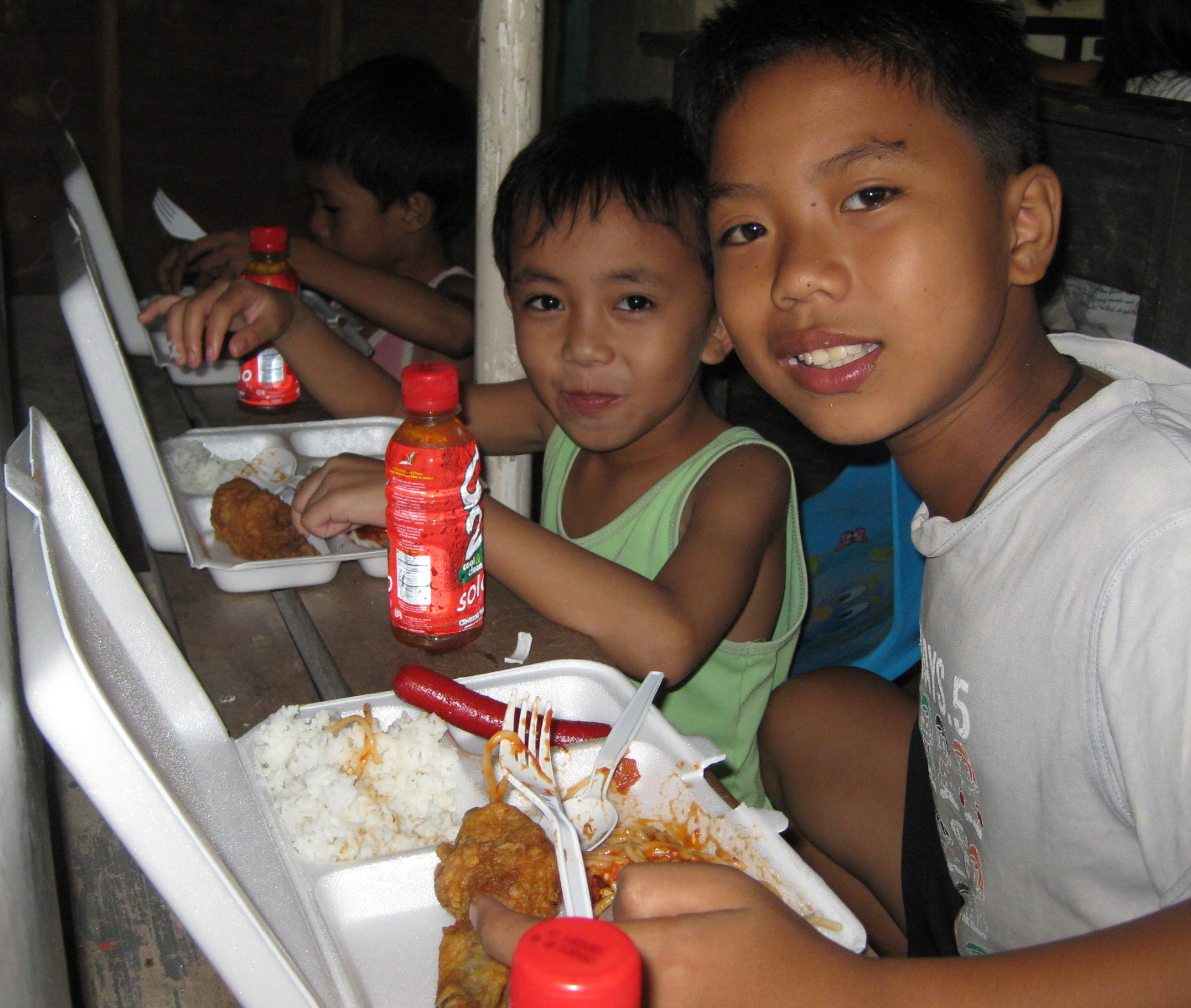
A smile on everyone's face, is a priceless Christmas gift. (Thanks to Bejun & Michelle, and to Jessica May, Jean and Mat for making us part of your cause).

Amid the test of times, we still find way to help reach out during a gift giving for less fortunate kids initiated by my New York-based sister in law Michelle.
Mindanao gets a slice of greatness with Manny
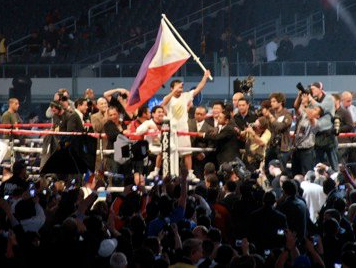
Photo courtesy of Texas-based former classmate Joel Villegas, taken minutes after the fight.
For the next few days, Mindanao will get its fair share of national and international media attention that is opposite the traditional “restive south, conflict-ridden, strife-torn, war zone, kidnappers’ haven, terrorists’ refuge” kind of convenient media labeling and tagging.
As we turn the pages of online news sites and blogs, and browse through national papers, it’s a sigh of relief to see Mindanao being referred to as Pacman’s humble origin. This is the period when the number of negative stories about Mindanao are outscored, out-punched and virtually KO’d by the stories of Manny’s triumph–particularly with reference to him being congressman of Sarangani and son of Mindanao.
I remember in 2006, I sought the help of Carol Arguillas, MindaNews editor-in-chief, who then tapped Professor Tony de Vera and his associates from UP Mindanao, to undertake a study on national media reportage of Mindanao. Few months later, the study entitled, “Reporting Mindanao: Content Analysis of National Broadsheets and Their Coverage of Mindanao” was completed.
The results weren’t surprising. It validated the findings of an earlier similar study done by the Center for Media Freedom and Responsibility (CMFR) in 2000, which cited that 7-8 out of average 10 stories about Mindanao as reported by major national broadsheets are about war, conflict, kidnapping, terrorism and similar topics revolving around violence.
In the 2006 paper by Carol, Prof. de Vera et al., what was worth noting is that for the duration of the study, negative stories about Mindanao were shun by stories of Manny knocking out Mexican legend Erik Morales. While the stories generally refer to Manny being the greatest boxer, Mindanao was referred to on a number of times as the place of his humble beginnings.
Apart from the usual reduction of crime rates and armed clashes between government forces and rebel groups when the country is in a state of standstill each time Manny fights, the labeling of Mindanao both by national and international media is also accorded with better perspective both in pre-fight and post-fight coverage. And that every time Manny raises the Philippine flag inside the ring, Mindanao in particular, gets a slice of his greatness.
Study says too much TV bad for kids: Time to wrest control of the remote control
This has been a lingering cause of on and off household discussion cum mini-debate as to whether or not Yuan’s favorite cartoons –Cars, Pooh, Barney, ABCs etc., are effectively aiding him along the lines of TV stimulated learning. He does remember a few lines, gestures, and incomprehensible babblings.
But as expected, he tends to afford more attention to action packed shows, than those that were suppose to inject more amount of educational learning.
I admit being guilty (beyond reasonable doubt) of overexposing him to the screen (to the point of buying him his own portable DVD player with monitor). And judging the way he behaves so far, my observations are likely leaning towards supporting the study’s findings.
Well, it certainly looks like there’s a looming battle for control over the DVDs at home in the next few days, and my problem is—in previous similar fights I always end up the one conveniently losing over the little ‘giant’ one, lest I cover my ears and ignore a deafening howl.
Twitter Explosion: Understanding the Power of the New Platform for Global Public Messaging
 “Follow me on Twitter.” For most of today’s generation especially those who are savvy about current popular social networking services, it’s easy to appreciate what this buzzy phrase is all about.
Twitter is the newest form of social networking and microblogging service that enables users to send and read other users’ brief or encapsulated messages and updates, called “tweets,” using computers or mobile devices with Internet access.
While it originally started mainly with text-based posts of up to 140 characters (20 characters less of mobile SMS messaging) shown on each user’s profile page, tweets have quickly evolved to now include shortened website resource locators that lead to message sources, mostly either blog or news sites.
By default, tweets are visible to anyone but privacy settings allow access modifications where senders can restrict message delivery only to their friends list. Those in the list who subscribe to the user’s tweets are called followers, and are doing the act of following on every user’s tweets.
Twitter started as an experiment in 2006 when Jack Dorsey, a 30 year-old American software architect from St. Louis, Missouri, thought of merging ‘away-message’ with the freedom and mobility of SMS messaging. An acclaimed outstanding innovator at such age, he would later be famously known as the creator of Twitter.
 By tapping the vast resources of real-time information network via Internet technology, Twitter draws its popularity from millions of people all over the world, many of whom post tweets as often as every second to let their ‘followers’ know what’s happening.
Most of the tweets today come in the form of random thoughts, expressions of emotions, state of mind, opinion, reactions, conversations, and some even personal rants. A significant chunk of messages, however, are more purposive like breaking news, announcement of important events as well as clever posts that wittingly or unwittingly bear advertising and marketing undertones.
Overall, Twitter’s timely bits of information that quickly spread across a global mass of people, general public, online friends and associates, as well as nations and civilizations, can help make better choices and decisions while creating the platform to influence on what’s being tweeted about around the world.
From the ordinary individual to the most powerful person on earth (like US President Barack Obama, whose rise to Presidency was also partly propelled by the power of social networking services such as Facebook and Twitter that helped generate campaign funds and volunteer support), Twitter in more ways than one, makes the powerful connection.
In 2007, barely a year following its launch in the U.S., Twitter had only about 400,000 tweets posted per quarter. Then in 2008, it pole-vaulted to 100 million tweets posted each quarter. By the end of 2009, it reached an incredible record of total 8 billion tweets posted. This year, it is projected to double to 16 billion tweets.
Leading technology experts are one in citing that Twitter has experienced an explosion in global traffic over the past year, establishing itself as one of the most-visited social networking sites across the universe, including the Philippines which ranked as 6th top Twitter user according to a study released recently, which showed Twitter penetration highest in Indonesia, followed by Brazil, Venezuela, Netherlands, and Japan.
As of the latest ranking by Twittercounter.com that tracks statistics of top 10 million Twitter users across all continents, the following emerged as the world’s top 5 Twitter users based on the number of followers (as of September 30, 2010):
1) Multi-awarded singer Lady Gaga (@ladygaga) with 6.5 million followers;
2) Britney Spears (@britneyspears) with 6 million;
3) Hollywood hunk Ashton Kutcher (@aplusk) with 5.8 million;
4) US President Barack Obama (@BarackObama) with 5.54 million; and,
5) Teen sensation Justin Bieber (@justinbieber) with 5.50 million followers.
With about 1 in every 3 human beings connects to the Internet, and with 3 in every 4 global Internet users access social networking sites regularly, Twitter becomes one of the most ubiquitous activities across the web, as more users around the world have become acquainted with connecting and expressing themselves through this social media.
Indeed, Twitter is the evolution of mobile communication. While it is not about to replace SMS, Instant Messaging, or email, it nevertheless brought forth a new public dimension to the rapidly escalating global messaging.
Follow me @yomontenegro on Twitter.
Oh’ baby it’s a wired world!
Technology has almost completely gotten into us already and the way it’s evolving at record pace, I wouldn’t be surprised if one day, no human being is unhooked to the net.
Here’s the latest amazing stats as of June 30, 2010, based on the Internet Usage and World Population Statistics put together by InternetWorldStats.com, based on data from the US Census Bureau, Nielsen Online, International Telecommunications Union and other reliable sources:
a) Current Estimated World Population: 6,845,609,960 (or roughly 6.8 billion)
b) Internet Users as of December 31, 2000: 360,985,492 (or some 361 million)
c) Internet Users as to Today: 1,966,524,816 (or about 2 billion)
d) Internet Growth 2000-2010: 444.8%
This simply means that almost 1 in every 3 human beings uses the most complex and intricate web ever known to the 21st century civilization—world wide web or the Internet.

Internet as another universe. (Photo courtesy of The Opte Project)
The astronomic growth of Internet indeed, triggered the dramatic rise of online communication exchanges and interaction worldwide, bringing far ends of the globe virtually together.
Separated by continents and different time zones, people from all walks of life who have access to the Internet, whether using PCs or mobile devices, communicate to each other real-time.
WordPress, Facebook, Twitter, YM, Friendster, and many more…Oh’ baby it really is a wild, wired world!
“Major, Major” Blunder
I’m supposed to be busy doing major work on my talking points for a scheduled engagement tomorrow (minding that I still have to catch a 9:50 flight tonight), but recent events that have shaped the news across multi-media platforms (tv, radio, newspapers, internet) these past three days kept derailing my train of thoughts.
From the car radio, to the parking lot, inside the elevator, to the office lobby and on my computer– what greeted me are same stories and discussions about major, major blunders that put the Philippines in a bad global spot the last few days.
Blunder must have been an utterly undesirable word that Wikipedia, or popularly known as online encyclopedia, defined it as “a particularly bad mistake.” Sometimes in jest we refer to it as “wrong mistake.”
Redundantly so.
Last Monday the world witnessed blow-by-blow accounts of a hostage drama unfolding that led to an unnecessary and ghastly bloodbath involving innocent lives of foreign tourists from Hong Kong.
I could imagine several hours before the infamous hostage-taking incident, they could be hopping inside the bus with much enthusiasm about their tour itinerary on that day. But by turn of fate, many of them never made it to step out of the bus alive, while the rest who survived will have memories of unimaginable fear and trauma, horrifying ordeal and near-death experiences forever etched in their minds.
This was a major blunder everyone saw. A handling of crisis riddled with errors and mistakes, which the authorities unhesitatingly admitted.
On Tuesday, waking up to a new day but with the previous day’s horrors still lingering in mind, many of us pinned quite a deal of our hopes for some sort of redemption from bad image and a timely remedy for distressed spirits, to a possible capture of the Miss Universe crown.
Philippines’ bet Venus Raj impressed many including the judges, of her fantastic showing from pre-pageant events leading up to the big coronation night in Las Vegas.
As the say, when the going gets tough, the tough will surely get going. And rightly so, besting the rest of the beauties in the preliminaries, Raj made it to the magic five– a point in the competition where all five being equally beautiful, the one with the smartest answer takes the coveted crown.
Frustratingly to some, she bungled a crowning opportunity with her now famous “major, major problem” legacy lines (remember Melanie Marquez’s long-legged leg?). But she cannot be faulted. Everyone knows she did her very best, to achieve a feat Filipinos should be proud of.
Reacting to unfair criticisms, my good friend and former Red Horse beer buddy Louie shouted out in his FB account:
“is annoyed by people who kept on saying that Venus Raj blew her chances in the recent Miss Universe pageant…Kay ngano, beauty queen pud mo? Na-koronahan na mo? Naka apil na ba mo ug beauty contest? Do you know how hard it is to answer questions during a beauty pageant? Or guapa ba mo, to begin with, kay beauty contest man jud ni, dili quiz bee or debate?
Expectedly, it drew several checks, likes and ‘second the motion’ comments. But what impressed me is the comment made by former officemate Cris, whose wit has never failed to shine these years, said:
“when you raise your own bar of excellence, people outside you raise that bar much higher. the bar of expectations is always higher than the bar of excellence. but what really matters in the end, the matter that makes one sleep soundly at night is when he/she is convinced that she/he has done her very best!
Congratulations to Venus!”
We didn’t exactly get what we wished for, but in the end it was major, major enough to make us proud, and a major, major respite from Monday’s major, major blunder.
And now, let me go back to my major, major work!
My career is an unending transition
I have spent the last 14 years earning a living out of a job I never went to college for— a job I opted to take in spite of protestations by those dear to me and amidst the lure of viable opportunities abroad.
“You’re a nurse, why don’t you make productive use of your profession earning a handsome pay abroad?” many have asked. I didn’t have a standard reply. It would always depend on who posed the question.
I love writing messages, speeches and news releases, speaking to the public and being engaged in a work that matters to people and society. In other words, I am always inclined to do something that is short of politics but not politics at all. (I have long abandoned my childhood dream of becoming a politician like my grandfather who was a former mayor and my father who used to serve as a municipal councilor.)
I just want to be where I am going to be happy and where I find fulfillment—this was me, some 14 years ago.
Having spent nearly a decade and a half working from one government office to another (one donor-funded project and five or six major government bodies) has enabled me to handle career transitions quite well.
One good thing about having a passion and being able to specialize in an area of concentration is that you wont find it hard to land a job, instead, will easily allow you to move up to the career ladder.
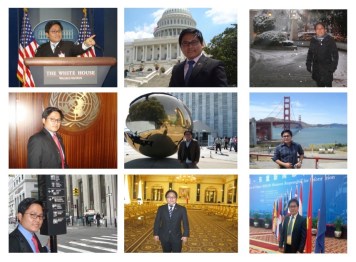
But as to whether or not a sturdy career has been built over the years is a reality I have learned to come to terms with. I had been to an office that brought me to all corners of the world: from the Island of Mindanao to Manhattan Island in New York, and from the alps across the West to the desserts of the Middle East.
I have had the privilege of working in another office that gave me my break as a spokesperson and host of a nationally-aired state-run television program (which won a 2008 Anak TV Seal Award).
I have had the great opportunity to brush elbows with high profile government officials right in the most high profile office of the land–Malacanang.
I have worked and engaged with many people dealing with the most conflict affected-areas of Mindanao and advocated for support from a number of development organizations.
It was a career I couldn’t ask for more. More than anything else, it was a fulfillment of a dream.
But just like any other government career founded on co-terminous nature of appointment, mine has always been subject to change of leadership and administration, oftentimes a price one has to pay for working in a high profile office.
As it was, my relatively young career has spanned across four administrations: from Ramos to Estrada, to Arroyo and Aquino, kind of illustrating a feat of rising from the ranks, though in various key offices attached to the Office of the President.
Each time there’s a change of administration, I always find myself dealing with the reality of having to go through transition. Some had asked why didn’t I take CESO way before. Well, my career, or I thought so, was founded on absolute commitment to perform and deliver, against the backdrop of lack of security of tenure.
And here comes transition time again. I couldn’t tell for sure what my next moves would be. I am fortunate to have quite a number of options, either keeping at step with my passion for government work, or moving on to something economically fulfilling job outside government.
Through the years, since I decided to choose government work over a financially-rewarding nursing career abroad, my job entailed seemingly endless crossroads.
However, this time around, it’s no longer just about building a sturdy and fulfilling career—but securing a better future not just for me, but for my family.
My career has been an unending transition– and I have decided no longer to keep it that way.
Me at 36 (a repost)
Some people dread the thought of turning a year older especially when there is not much to reckon with in life, in terms of noteworthy feats. In contrast, there are those who look forward to turning a leaf of triumphs, yet to another page of success.
Looking back at life is invariably viewed with a standard gauge: how far have we gone in terms of success, and how far do we think could we go further?
When I was young, I was awed by stories about those who made their million at age 25 or had been to as many as more than 10 countries when they reached 30. I kept savoring the thought that many have proven something out of their lives by the time they turn 35.
But just how does one define success when he reaches a certain age in life? I often ask.
I am past 35, but still quite far from counting a million in my account. I’m in my prime but I deem the future looks far from being clearly certain on account of challenges that lie ahead. I may have been to as many as more than 10 countries but after all those travels, I realized the only thing that matters is an album of photos and some good memories. Once you’re back home, you’re also back to reality.
At 36, what do I have? Well I say, I may not have the most in life, but I have much of what’s best in life: God who never fails, a loving wife and an adorable son, a supportive family, and good health. I have a work that pays enough to cover for my bills, plus a little bit of savings for the rainy days. In the midst of this all, I have a multitude of friends who can define what friendship really means.
I know I should have already done something more than I did, have acquired more than what I had, have been to places beyond those I’ve been to, and be someone more than who I am today.
But those, to me, are not the true measure of success.
I am happy at 36, truly happy with my family and reasonably fulfilled at being able to work on something that matters to society. But then again, many things can happen when I become 40 or 50 and so on.
In the end, life is a matter of choice and not purely by natural circumstances. We all have a shot at destiny and how we do it makes us what we become.
This is me, at 36.
Media awakening: A peek at how information should have shaped our views and opinions
The world of multi-media continues to flood us today with information that test the limits of our ability to appreciate, understand and respond.
Television programs of leading networks bombard viewers with violence and entertainment rather than intellectually stimulating presentations. Major daily broadsheets including tabloids and regional newspapers splash sensational headlines over stories that build a culture of peace and harmony. Radio programs saturate the airwaves with discussions that heave more on personality conflicts than issues and actions: All summed up, these contents easily drown out whatever independently formed views we have about today’s current realities.
Today’s opinions are shaped on people’s minds not mostly on account of logical appreciation of issues and facts, but largely by persistent presentation of biased and politically loaded stand of quite amount of information materials we get from newspapers, televisions and radio programs.
Principled thinking had become invariably modified or altered by the swinging of personal conviction from one stand to another depending not on how credible information is presented but on how emotions are graphically played up to sway sentiments to a directed end.
This reality partly explains why many have started to become passive and would rather offer cynical views about the future, with confidence waned and enthusiasm lost.
There is no certainty if media awakening will ever emerge or is possible in not too distant future. But with the way the general public reacts to major political developments, it will be a while before we see Philippines as a nation united, with people solidly rallying behind the government.
 Passing Thoughts